

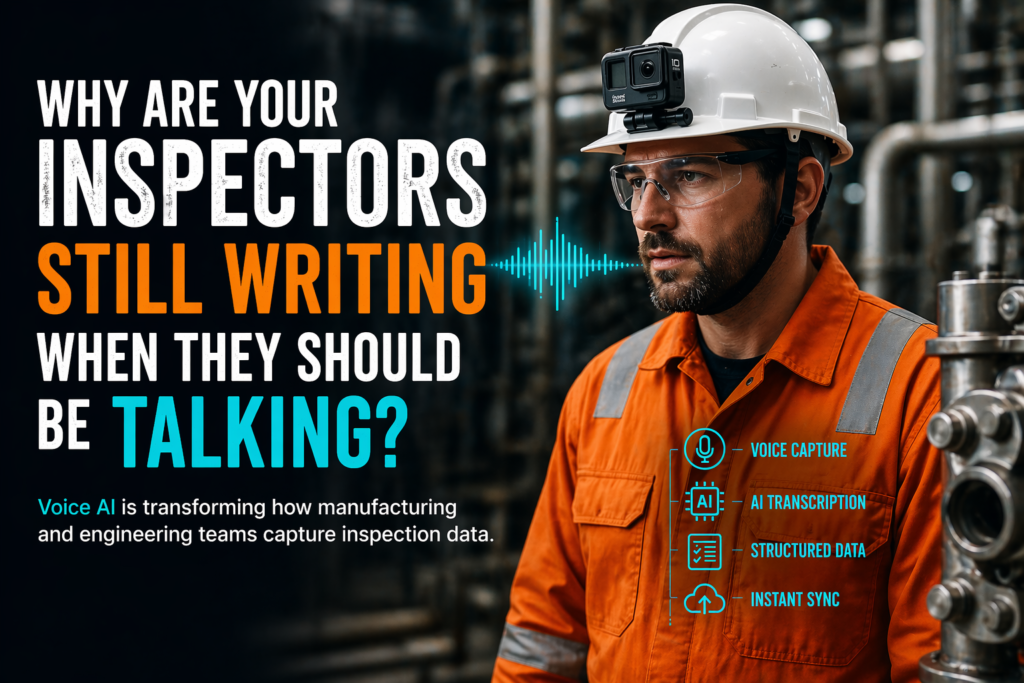
Voice AI is transforming how manufacturing and engineering teams capture inspection data — and it’s long overdue.
Every inspection starts the same way: a work order is issued with a defined scope, whether it’s inspection, overhaul, or repair. Alongside it comes a checklist or template that needs to be completed. In most cases, this still means pen and paper. In more digitised environments, it might be a tablet or PC.
When all is said and done, you’re left with greasy sheets covered in hurried handwriting, passed over to the operations team to decipher and transfer into databooks or similar systems.
It’s a workflow as old as the industry itself. Because it’s familiar. The “tried and tested” way that rarely gets questioned. So what if there are occasional issues with data quality? Or someone has to interpret handwriting that only the inspector can read? And what about the constant stop-start nature of the job. Tools down, write something, pick everything back up again?
Pen and paper has become the default. It’s what we know, so it’s what we accept.
But expectations have changed and so have the demands on the people doing the work. There has to be a better way. Something more efficient. More accurate. Something that delivers consistent results, while also making the process more accessible for those who may struggle with traditional written input, such as individuals with dyslexia or dyspraxia.
The hidden cost of paper-based inspections
Quality checks, maintenance surveys, safety inspections, equipment sign-offs – these are the backbone of operational integrity in any manufacturing or services environment. These are ingrained part of the workflow processes from the times of Henry Ford. But the way most organisations capture this data hasn’t had any meaningfully change or upgrade in decades. Forms get printed. Inspectors write things down. Someone transcribes it into a system. With all the information being passed from hand to hand, discrepancies appear. Non-conformances get logged late — or not at all. At best, there will be tablets with restricted fields that have no way to capture comments or photo attachments.
The result? Incomplete records, delayed reporting, compliance exposure, and a mountain of admin that lands on the people least likely to have time for it: your operations and QHSE managers.
We’ve seen inspectors in our own pilots spending upwards of an hour per shift purely on paperwork. Multiply that across a team, across a month, and you’re looking at a significant chunk of skilled time that adds zero value to the actual work. That’s time that could be spent on the next job.
What changes when you add voice
The shift to voice-first data capture is one of the most practical (and underused) applications of AI in manufacturing today. It’s a concept that’s uncomplicated and already being used by some industries such as ROV pilots in Subsea. They use voice recordings to describe their activities and what they see during deployment, but those recordings aren’t necessarily transcribed.
When it comes to manufacturing though, it could be as simple as replacing some of the typing or writing with hands-free voice recognition.The inspector speaks, and AI transcribes and structures the data in real time in the correct location. Each field, individually completed with real time data, by the person carrying out the inspection. It then confirms the information and sends it back to office for the people who need it.
All automated. No clipboards. No transcriptions. No “I’ll finish this later.” Both hands stay on the job. Eyes stay on the asset.
What makes modern voice AI genuinely useful on the shop floor is its ability to handle the reality of the environment. Things like background noise, domain-specific terminology, multi-section inspection forms, variable connectivity, accents and language interpretation. It has all of those obstacles covered. There are so many possibilities. Let’s not forget to mention offline capability. A significant amount of inspection work happens in areas where signal isn’t guaranteed for services jobs. The North Sea doesn’t always want to cooperate with our technological needs. The best systems capture voice locally and sync the moment a connection is restored, so there’s no gap in the record.
The quality of data improves over time — not just the speed
Is it always faster than ticking a single box? No, and it is important to be realistic about that. But the gains in quality and completeness far outweigh that limitation. For inspectors taking measurements, tightening bolts, or working in confined spaces, it is a significant step forward. They can describe what they are doing in real time without stopping, capturing detail that would rarely make it into a form. It also works alongside existing checklists, not instead of them. Imagine an inspector being able to ask a voice assistant for clarification mid-task, or being prompted through critical steps as they work.
Consider a scenario familiar to anyone who has worked in pressure testing — a BOP blowout at 20,000 PSI. These things happen, and when the investigation comes, the root cause is rarely one big failure. It’s usually a small step missed under pressure: bolts on a BOP head not tightened in a star pattern, for example. Loss of time, loss of money — and potentially much worse. Now imagine the inspector had a voice assistant prompting the next step, or could describe the process out loud as they went. That single change in how the work is recorded could be the difference between a near miss and a report nobody wants to write.
The use of voice as an AI assistant is a new way of working. Think of it as an intelligent Alexa or Siri — built for inspectors.
Overall, think of voice-first AI as a method that enriches the data of the inspection workflow. Add to that the ability to attach photos or even videos, and you’ve got richer, more complete records without much extra effort. Just a change in how the inspector records findings is all it takes to improve the process.
The smart factory doesn’t stop at the machine
Manufacturing has invested heavily in connected equipment, sensors, robotics, and automation across the UK in recent years. That is a natural direction for innovation in a competitive industry. But there is still a gap between what machines capture and what the people carrying out inspections observe, and that gap sits within the inspection and quality process.
Voice AI bridges that gap. It turns the knowledge and observations of your most experienced people into structured, searchable, reportable data instantly, without adding friction or a steep learning curve to their work.
In June 2026, we will be bringing this to life at Smart Manufacturing Week. We will be demonstrating exactly how voice AI can transform workflows across maintenance walk rounds, quality checks, and asset integrity inspections, live at the stand.
If you are responsible for operations, quality, or QHSE and are still relying on paper-based or form-first inspection processes, come and see it for yourself. Bring a checklist and see how quickly it can be set up.
The voice technology you are looking for already exists, and it has improved significantly in recent years through advances in AI. The return on investment is real.
The only question is how long you are prepared to keep paying for inefficiency.
HAMI Voice is a voice-first AI inspection reporting platform built for operations, quality, and field inspection teams in manufacturing, energy, and industrial services. Find us at Smart Manufacturing Week 2026, NEC Birmingham, 3–4 June.